The Retention Crisis: Why Women Keep Leaving IT

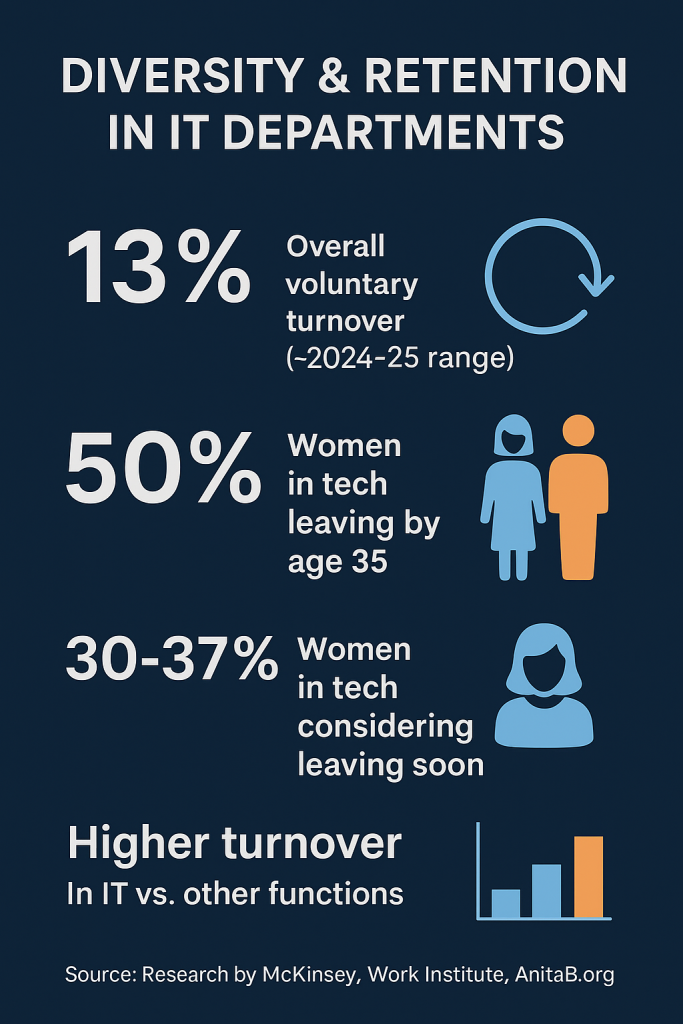
 Despite decades of progress and billions invested in diversity initiatives, the technology sector still faces a critical retention challenge — especially when it comes to women. While overall voluntary turnover across industries sits around 13%, attrition within IT and digital functions remains higher. Beneath the surface, the problem is not simply about numbers; it’s about culture, progression, and belonging.
The Leaky Pipeline
The data is stark. Around 50% of women in tech leave the industry by age 35, (Accenture 2020) a rate far higher than in other professions. Another 30–37% are considering leaving within the next year. (TechTalent Charter. 2023)These are not isolated figures — they reflect a systemic issue in the environments women experience once they enter IT.
Women in technical roles often report a lack of visible career pathways, limited sponsorship, and a culture that prizes long hours and constant availability. For many, the cost of “fitting in” outweighs the rewards of staying.
Beyond Representation: The Culture Gap
Enterprises have made gains in recruitment, but diversity without inclusion doesn’t work. McKinsey’s 2023 research found that women in tech are still underrepresented in senior roles, despite steady entry-level hiring. Without inclusive management practices and equitable advancement, women face stalled careers and opt out of the sector altogether.
Compounding the issue, recent layoffs across tech have disproportionately affected women, eroding years of progress. The message many women hear — intentionally or not — is that their positions are expendable.
Why This Matters for CIOs and IT Leaders
Losing experienced technologists is more than a diversity problem — it’s a business problem. High turnover drives up costs, drains institutional knowledge, and weakens innovation. Retention and inclusion should be treated as strategic imperatives, not HR afterthoughts.
Successful IT leaders are addressing this by:
-
Building sponsorship networks for women in technical and leadership roles.
-
Auditing promotion and pay equity to eliminate systemic bias.
-
Designing flexible career paths that recognise different work styles and life stages.
-
Creating visible role models and fostering psychological safety in teams.
The Way Forward
Women are not leaving tech because they lack ability or ambition. They are leaving because the system is not designed for them to thrive. Changing that requires more than mentoring programmes or annual DEI reports — it demands accountability at the leadership level.
As CIOs and technology leaders face skills shortages, AI disruption, and digital transformation, retaining diverse talent isn’t optional — it’s mission critical.


I think there is an element of ageism at play here too. Men are also affected by agism as businesses seem to fail to consider / remember people are now working to 70 so not hiring older people is wasting opportunity and resources. This may be affecting women too to a greater extent. Women are having children later in life as they get their careers going. This means that if and when they take a break from the workplace for family reasons they are older and when ready to return to work they are older and the recruitment is ageist, even when it tries not to be. Hiring managers can be nervous about potentially hiring someone older and more experienced than themselves out of fear for their own career.